Crypto lending market size and leverage trends
The crypto lending market has reached a new scale, with crypto-collateralized lending hitting an all-time high of $73.59 billion by the end of Q3 2025. This surge, reported by Galaxy Research, signals a maturation of the sector as institutional and retail participants increasingly view lending as a core utility rather than a speculative side hustle. The global crypto lending platform market is now projected to reach $25.06 billion by 2030, growing at a compound annual rate of 18.5%.
A structural shift is underway within this growth. While collateralized debt positions (CDPs) once dominated the onchain landscape, pure lending applications now account for more than 80% of the market. This represents a dramatic departure from Q4 2021, when CDPs held a 53% share. The migration toward dedicated lending protocols suggests that users are seeking specialized yield generation and borrowing tools rather than just leveraging assets for exposure.
To understand the velocity of this market, we can look at the broader crypto asset performance that underpins these lending pools. The following chart illustrates the recent price action of Bitcoin, the primary collateral asset for the majority of these lending positions.
This convergence of record capital inflows and protocol specialization highlights the resilience of the crypto lending market. As the sector evolves, the distinction between centralized finance (CeFi) and decentralized finance (DeFi) lending continues to blur, with both models adapting to meet the demands of a $73 billion+ industry.
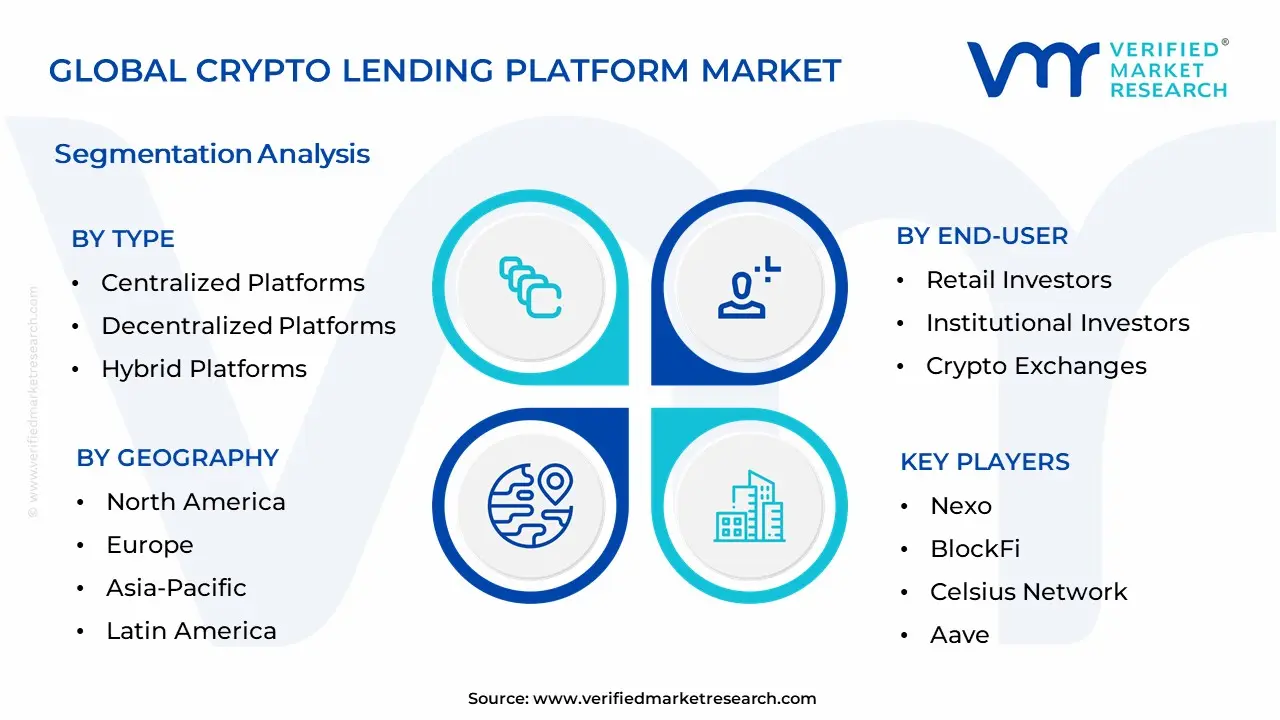
DeFi versus CeFi infrastructure
The choice between decentralized finance (DeFi) and centralized finance (CeFi) lending is fundamentally a choice about who holds the keys. In CeFi, you are effectively opening an account with a financial intermediary. Your assets are pooled into the platform’s internal ledger, and you rely on their traditional security infrastructure and internal controls. In DeFi, you interact directly with smart contracts on the blockchain. Your assets remain in your wallet until you explicitly approve a transaction to a lending protocol.
This structural difference dictates where the risk lies. CeFi platforms like Binance or Coinbase act as custodians. They manage the custody of your funds, meaning you are exposed to counterparty risk—the possibility that the firm becomes insolvent or mismanages assets, as seen in historical collapses. DeFi protocols like Aave or Compound remove the middleman. You retain self-custody, but you inherit smart contract risk. If the code contains a vulnerability, hackers can exploit it, and there is no customer support team to reverse the transaction.
The table below contrasts the core operational differences between these two lending rails.
| Feature | DeFi Lending | CeFi Lending |
|---|---|---|
| Custody | Self-custodied (User holds keys) | Platform-custodied (Platform holds keys) |
| Access | Permissionless (Anyone with wallet) | Permissioned (KYC/Identity required) |
| Yield Source | Direct borrower interest | Platform lending & trading spreads |
| Primary Risk | Smart contract exploits/bugs | Counterparty insolvency/hacks |
| Regulation | Generally unregulated/grey area | Heavily regulated financial entity |
The yield mechanics also differ significantly. In DeFi, rates are algorithmic, adjusting in real-time based on the supply and demand of specific assets within the protocol. In CeFi, rates are set by the platform, often derived from their broader lending books, proprietary trading, or staking activities. While CeFi may offer higher, more stable yields for stablecoins due to their institutional lending arms, DeFi offers transparent, on-chain visibility into where that yield originates.
Where yields come from
Crypto lending generates income primarily through borrower interest payments. Lenders deposit cryptocurrency into a platform and earn returns as borrowers repay loans with interest. In decentralized finance (DeFi), these transactions are executed via blockchain-based smart contracts, allowing users to select specific money markets to lend to based on current demand and rates [Hedera].
In centralized finance (CeFi), the model mirrors traditional banking but with higher rates. The platform acts as an intermediary, pooling user deposits to lend out to institutional borrowers or margin traders. The spread between what the platform pays lenders and what it charges borrowers constitutes the primary yield source.
Risk factors in crypto lending
The yield comes with distinct risks that differ between CeFi and DeFi. In CeFi, the primary threat is platform insolvency. If the centralized entity lends out deposited funds to failed ventures or suffers from poor risk management, lenders may lose their assets, as seen in historical collapses like Celsius and BlockFi. Regulatory scrutiny also adds uncertainty to CeFi operations.
DeFi risks center on smart contract exploits and protocol vulnerabilities. While blockchain technology is immutable, the code governing lending protocols can contain bugs or logic errors that hackers exploit. There is no customer support to reverse transactions; if a protocol is drained, the funds are often gone. Additionally, DeFi yields can be volatile, driven by token incentives that may disappear suddenly, altering the risk-reward profile of a lending pool.
Both models require rigorous due diligence. Lenders must assess the counterparty risk in CeFi and the code security and economic sustainability of yields in DeFi. The IMF notes that recording these activities in macroeconomic statistics remains complex, highlighting the evolving and sometimes opaque nature of these financial instruments [IMF].
Institutional adoption signals
The crypto lending market is shifting from a speculative playground to a regulated financial utility. Institutional players are entering through compliant CeFi platforms and tokenized treasury products, driving a maturation that prioritizes capital preservation over yield-chasing. This transition is reshaping the lending landscape, where borrowing and lending markets now play a significant role across both decentralized and traditional financing rails [[src-serp-4]].
Galaxy Digital’s Q3 2025 research highlights a structural pivot: lending applications now account for over 80% of the onchain market, a stark contrast to the 53% share held by crypto-collateralized debt positions (CDPs) in late 2021 [[src-serp-1]]. This surge reflects institutional preference for direct lending and stablecoin yield strategies over complex leveraged derivatives, signaling a demand for transparent, auditable on-chain credit.
Tokenized treasury bills and regulated CeFi lending pools are bridging the gap between traditional finance and digital assets. By offering yield comparable to short-term government debt with the liquidity of crypto, these products attract corporate treasuries and family offices seeking efficient capital deployment. This convergence is not just about volume; it is about building a resilient infrastructure that can withstand market cycles.
Evaluate crypto lending platform safety
Before locking capital into a DeFi protocol or CeFi exchange, you need a rigorous due diligence framework. The crypto lending market remains high-stakes, where platform solvency and smart contract integrity are the primary defenses against total loss.
Check if the platform publishes real-time Proof of Reserves (PoR). Legitimate CeFi platforms must show 1:1 asset backing, while DeFi protocols should link to on-chain dashboards that verify collateral ratios and available liquidity.

Look for recent, published security audits from reputable firms like CertiK or Trail of Bits. An unaudited protocol is a gamble; a protocol with outdated or unresolved audit findings is a ticking time bomb.
For CeFi, verify if the platform holds licenses in major jurisdictions like the US or EU. Regulatory standing often correlates with stricter internal controls and customer fund segregation, reducing the risk of commingled assets.

Investigate the platform’s history. Have they suffered hacks or exploits? More importantly, did they fully compensate affected users? A clean history is ideal, but a transparent recovery plan is the next best thing.
| Feature | DeFi Protocol | CeFi Platform |
|---|---|---|
| Custody | Self-custodied via smart contract | Platform holds private keys |
| Transparency | On-chain ledger, fully visible | Proof of Reserves (often monthly) |
| Insurance | Protocol treasury or external funds | FDIC/SIPC (rarely for crypto) |
Common questions about crypto lending
Crypto lending platforms operate differently depending on whether you choose a centralized exchange (CeFi) or a decentralized finance (DeFi) protocol. Understanding the mechanics, profitability, and safety profiles of each model is essential before deploying capital.
Note: The chart above reflects general market conditions. Lending yields are dynamic and do not track spot price movements directly.
No comments yet. Be the first to share your thoughts!